
Guitar scale · exotic
G Oriental Scale
Mode 5 of Double Harmonic Major: a dominant-sounding scale with ♭2, ♭5, a major 6th and ♭7.
Tap any note to hear it.
G Oriental Scale tab: all 5 positions
Each tab climbs from the low E string to the high e string. Play it up, then back down.
e|-----------------------------3-4-7-|
B|-------------------------5-6-------|
G|-------------------4-5-6-----------|
D|-------------3-5-6-----------------|
A|-------3-4-7-----------------------|
E|-3-4-7-----------------------------|
e|-----------------------------7-8-9-|
B|-----------------------6-8-9-------|
G|-----------------5-6-9-------------|
D|-----------5-6-9-------------------|
A|-------7-8-------------------------|
E|-7-8-9-----------------------------|
e|----------------------------------7-8-9-|
B|------------------------------8-9-------|
G|-------------------------9-10-----------|
D|-----------------9-10-11----------------|
A|-------7-8-10-11------------------------|
E|-7-8-9----------------------------------|
e|-------------------------------------------12-13-|
B|----------------------------------12-13-14-------|
G|-------------------------10-12-13----------------|
D|----------------10-11-14-------------------------|
A|-------10-11-14----------------------------------|
E|-12-13-------------------------------------------|
e|-------------------------------------------12-13-15-16-|
B|-------------------------------------13-14-------------|
G|----------------------------12-13-16-------------------|
D|----------------------14-15----------------------------|
A|-------------14-15-16----------------------------------|
E|-12-13-15-16-------------------------------------------|
How to play G Oriental on guitar
Find the root first: G is at fret 3 on the low E string and fret 10 on the A string. The blue notes on the diagram are every G on the neck; the gold ones are the rest of the scale's home chord (3, ♭5, ♭7), the safest notes to land on at the end of a phrase.
Learn it one box at a time. Position 1, the E shape, sits at frets 3–7. Once it's under your fingers, move to position 2 (the D shape) and play the notes the two boxes share, then keep going up the neck. After all five, the scale joins up into one pattern across the whole fretboard.
Degrees
| Degree | Note |
|---|---|
| 1 | G |
| ♭2 | Ab |
| 3 | B |
| 4 | C |
| ♭5 | Db |
| 6 | E |
| ♭7 | F |
Chords in G Oriental
Stack every other note of the scale and you get these seven chords. They are the chords that sound "at home" in G Oriental; tap one to see its shapes.
| Degree | Chord | 7th chord | Function |
|---|---|---|---|
| I | — | — | Tonic |
| ♭II+ | Abaug | Abmaj7#5 | Supertonic |
| III | — | — | Mediant |
| IV | C | Cmaj7 | Subdominant |
| ♭V | Db | Dbmaj7 | Dominant |
| vi | Em | — | Submediant |
| ♭vii | Fm | Fm(maj7) | Leading tone / subtonic |
Fretwise · Free on iPhone & Android
Practise G Oriental anywhere, even offline.
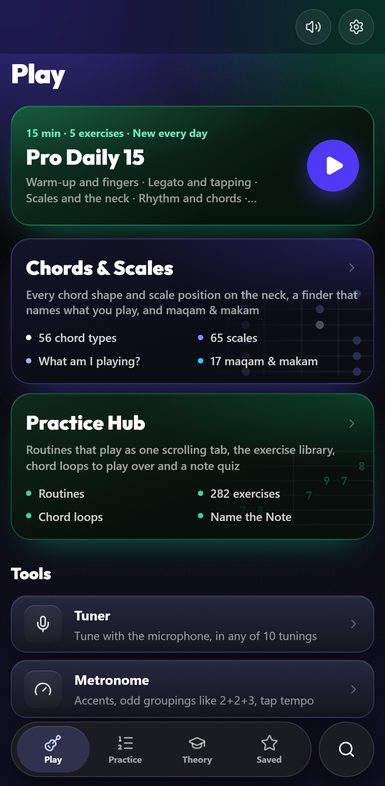
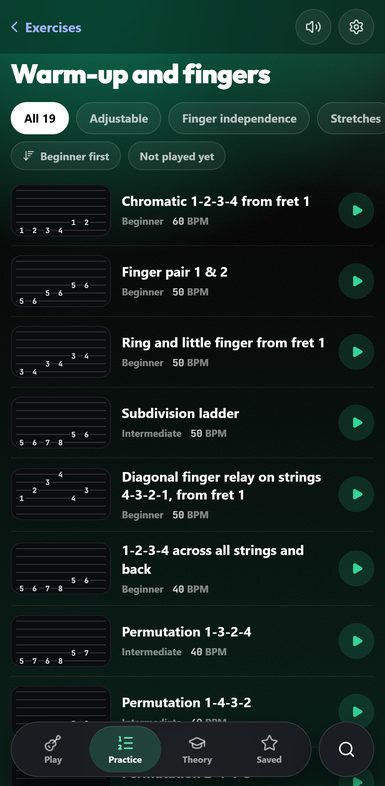
This page is a small slice of Fretwise. The app adds practice: exercises that play as tab, a new routine every day, and the tools to tune and keep time. On iPhone, iPad and Android, no sign-up.
Free
- 65 scales and 56 chord types in every key, with CAGED shapes
- A tuner with 10 tunings and a metronome from 30 to 260 BPM
- A new Daily 15 routine every day, plus free exercises
- Maqam & makam between the frets, and the Name the Note quiz
One purchase
- 282 exercises that play as tab, and routines with a speed trainer
- Chord & Scale Finder: tap the neck, get the name
- Theory Lab and the Progression Builder with 51 genre loops
- No subscription, ads removed
Questions
- What notes are in the G Oriental Scale?
- The G Oriental Scale has 7 notes: G, Ab, B, C, Db, E, F.
- What chords are in the G Oriental Scale?
- The chords of G Oriental are Abaug (♭II+), C (IV), Db (♭V), Em (vi), Fm (♭vii).
- What is the formula of the oriental scale?
- 1 ♭2 3 4 ♭5 6 ♭7, which is the step pattern H W+H H H W+H H W (W = whole step, H = half step).
- Where do I play G Oriental on the guitar?
- The root G is at fret 3 on the low E string and fret 10 on the A string. Position 1 (the E shape) covers frets 3–7, and four more positions connect it up the neck.