Exercises · Practice routine
A 15-minute guitar practice routine for beginners
Five parts, three minutes each: warm-up, picking, the neck, legato and rhythm. Every part below plays as a scrolling tab with a click, so you can follow it with the guitar in your hands. Press play, set the tempo where every note is clean, and move on when the three minutes are up.
The plan
| Time | Part | Exercise | Start tempo |
|---|---|---|---|
| 0:00 to 3:00 | Warm-up | Chromatic 1-2-3-4 from fret 1 | 60 BPM |
| 3:00 to 6:00 | Picking | Alternate picking across the strings | 60 BPM |
| 6:00 to 9:00 | The neck | A Minor Pentatonic, position 1 | 60 BPM |
| 9:00 to 12:00 | Legato | Hammer and pull, fingers 1-2 | 50 BPM |
| 12:00 to 15:00 | Rhythm | A to D changes | 30 BPM |
Fifteen minutes is short on purpose. It fits into a day when you do not feel like practising, and the days you play matter more than how long you play on each of them.
0:00 to 3:00
Warm-up: one finger per fret
Cold fingers are clumsy fingers. Three minutes of chromatic notes get all four fingers moving and teach them to land right behind the fret, where a note sounds clean with the least pressure.
- Put one finger on each fret, 1 to 4, and keep the fingers you are not using hovering just above the string.
- Press just hard enough for the note to ring. If it buzzes, move the finger closer to the fret before you press harder.
- Alternate the pick down and up, even on the string changes.
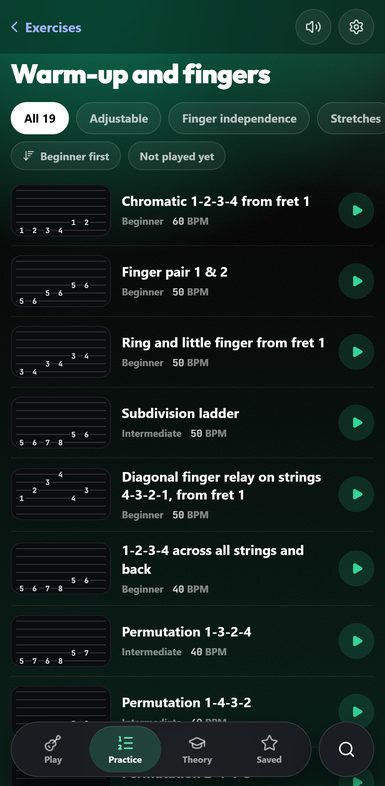
Start at 60 BPM. The goal for this exercise is 120 BPM, which takes weeks, not days. Open Chromatic 1-2-3-4 from fret 1 on its own page or swap in Finger pair 1 & 2 or Diagonal finger relay on strings 4-3-2-1, from fret 1 .
Tap a bar to start there.
Goal: 120 BPM
3:00 to 6:00
Picking: the picking hand on its own
Most beginner mistakes that sound like the left hand are really the right hand: a missed string, a late upstroke, a pick that digs in too deep. This block uses open strings, so the fretting hand rests and the picking hand gets your full attention.
- Hold the pick so only a few millimetres show past your thumb.
- Keep strict down-up strokes. When you cross to the next string, do not restart with a downstroke.
- Watch the click: each note should land exactly on it.
Start at 60 BPM. The goal for this exercise is 160 BPM, which takes weeks, not days. Open Alternate picking across the strings on its own page .
Tap a bar to start there.
Goal: 160 BPM
6:00 to 9:00
The neck: one scale position
The minor pentatonic in its first position is where a lot of rock and blues solos live. Playing it up and down every day turns it into a map you stop having to think about, and the same box works in every key once you move it.
- Say the note names, or at least the root, as you play. Knowing where the root is matters more than speed.
- Use the first finger for the lowest fret of the box and the third or fourth finger for the highest, and keep that rule all the way up.
- When it feels easy, try the same shape starting on a different fret: the notes change, the fingering does not.
Start at 60 BPM. The goal for this exercise is 120 BPM, which takes weeks, not days. Open A Minor Pentatonic, position 1 on its own page or swap in Natural notes on string 6 .
Tap a bar to start there.
Goal: 120 BPM
9:00 to 12:00
Legato: hammer-ons and pull-offs
Hammer-ons and pull-offs are how most licks get their flow, and they build the finger strength that also makes chords ring. Three even notes from one pick stroke is the whole skill; the hard part is keeping them even.
- Hammer with the tip of the finger, fast and close to the fret, like a small hammer and not a slow press.
- On the pull-off, flick the string slightly downward toward the floor instead of lifting straight off it.
- Listen for the second and third notes. If they are much quieter than the picked one, slow down.
Start at 50 BPM. The goal for this exercise is 100 BPM, which takes weeks, not days. Open Hammer and pull, fingers 1-2 on its own page .
Tap a bar to start there.
Goal: 100 BPM
12:00 to 15:00
Rhythm: clean chord changes
Songs are chords that change on time. Beginners usually know their chords but stop between them; this block trains the change itself, one strum per click, until the new chord is ready before the beat arrives.
- Before each change, look at which finger can stay on the string or slide along it. That finger leads the move.
- Move all the fingers together as one shape instead of placing them one at a time.
- Count your clean changes in a minute. That number going up week by week is the clearest progress you will see.
Start at 30 BPM. The goal for this exercise is 90 BPM, which takes weeks, not days. Open A to D changes on its own page or swap in G, down, down-up, up-down .
Tap a bar to start there.
Goal: 90 BPM
How to raise the tempo
- Start each part at the tempo where every note is clean, even if that is slower than the starting tempo shown.
- When two passes in a row are clean, press plus four or five times and keep going.
- If notes start to buzz or land late, go back to the last clean tempo instead of pushing through.
- The next day, start a few beats below where you finished. You will usually pass yesterday's tempo within a minute.
Stuck on one bar? Press Loop and drag its two ends around the hard spot, then play just that until it is clean.
Questions
- Is 15 minutes of guitar practice a day enough?
- For a beginner it is a good amount, as long as it happens most days. Fingertips toughen and new movements settle with repetition spread over days, so a short session every day does more than one long session a week. Play songs on top of it whenever you have more time.
- Should I practise with a metronome?
- Yes, from the first day, but slowly. The click shows whether a passage is really even, and it lets you measure progress in beats per minute. You do not need a separate one for this routine: every tab on this page, and every exercise in the Fretwise app, plays with its own click at the tempo you set. For songs and anything else you practise, the app also has a separate metronome, from 30 to 260 BPM, with accents, odd groupings like 2+2+3, subdivisions and tap tempo. Start where every note is clean and raise the tempo in small steps.
- My fingertips hurt. Should I keep going?
- Sore fingertips are normal in the first weeks and fade as calluses form; three-minute blocks with a short pause between them help. Pain in the wrist, forearm or the joints of the hand is different: stop, shake out, check that your thumb is not squeezing the neck, and rest if it continues.
- What should I do when the routine feels easy?
- Raise the tempo toward each exercise's goal, then change the material: another key or position for the scale, another chord pair for the changes. The Fretwise app does this for you with a new Daily 15 every day, built from the same five parts.
Fretwise · Free on iPhone & Android
A new Daily 15 every day, in the app.
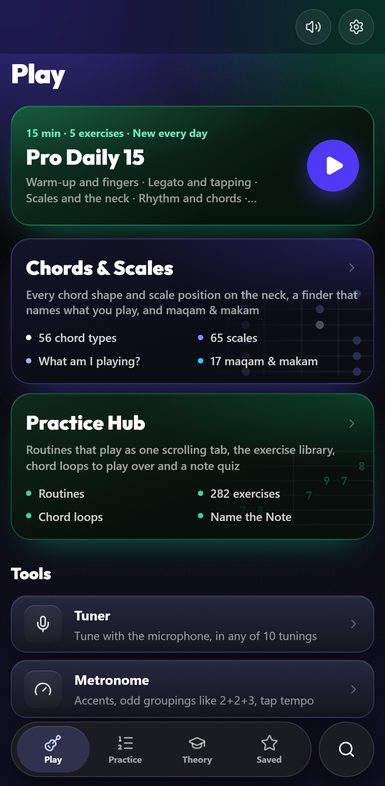
This page is a small slice of Fretwise. The app adds practice: exercises that play as tab, a new routine every day, and the tools to tune and keep time. On iPhone, iPad and Android, no sign-up.
Free
- 65 scales and 56 chord types in every key, with CAGED shapes
- A tuner with 10 tunings and a metronome from 30 to 260 BPM
- A new Daily 15 routine every day, plus free exercises
- Maqam & makam between the frets, and the Name the Note quiz
One purchase
- 282 exercises that play as tab, and routines with a speed trainer
- Chord & Scale Finder: tap the neck, get the name
- Theory Lab and the Progression Builder with 51 genre loops
- No subscription, ads removed